One prompt, four agents and a critic: Gemini 4 Argon builds a Japanese temple in Blender
From the OpenDrama Create Wiki
George Kenwright of Google DeepMind shows Gemini 4 Argon in Antigravity building a whole Japanese temple complex in Blender: a five-storey pagoda, a vermilion drum bridge, a lotus pond and a gilded altar hall. dotey (Baoyu) shared the subtitled demo with a Chinese summary. It's billed as one prompt, but that prompt carries a whole pipeline: rules, blueprints, references, a division of labour and a critic.
How it was made
- 01Skill docbuilding and look rules
- 02Gemini 4 Argonblueprints first
- 03Nano Banana4-angle reference sheet
- 044 subagentsone zone each
- 05Criticrender, compare, redo
- The prompt names a skill document,
architectural_environment_production, and asks for a temple complex with a pagoda in Blender 5.2. - Blueprints come first: CAD drawings (IfcOpenShell, ezdxf) compiled 1:1 into Blender.
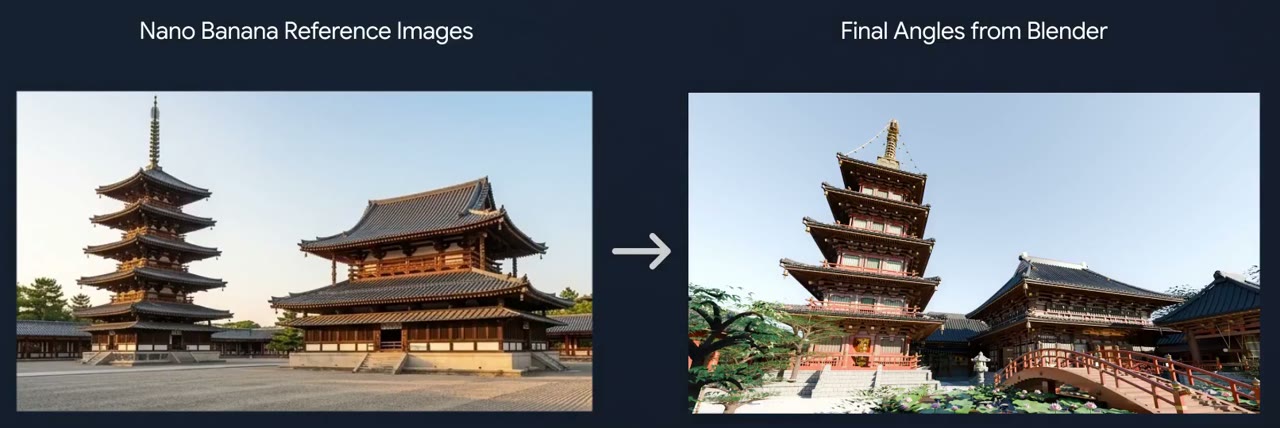
- Nano Banana turns the blueprints into a 2×2 sheet of photoreal views from 4 angles, to lock proportions and materials.
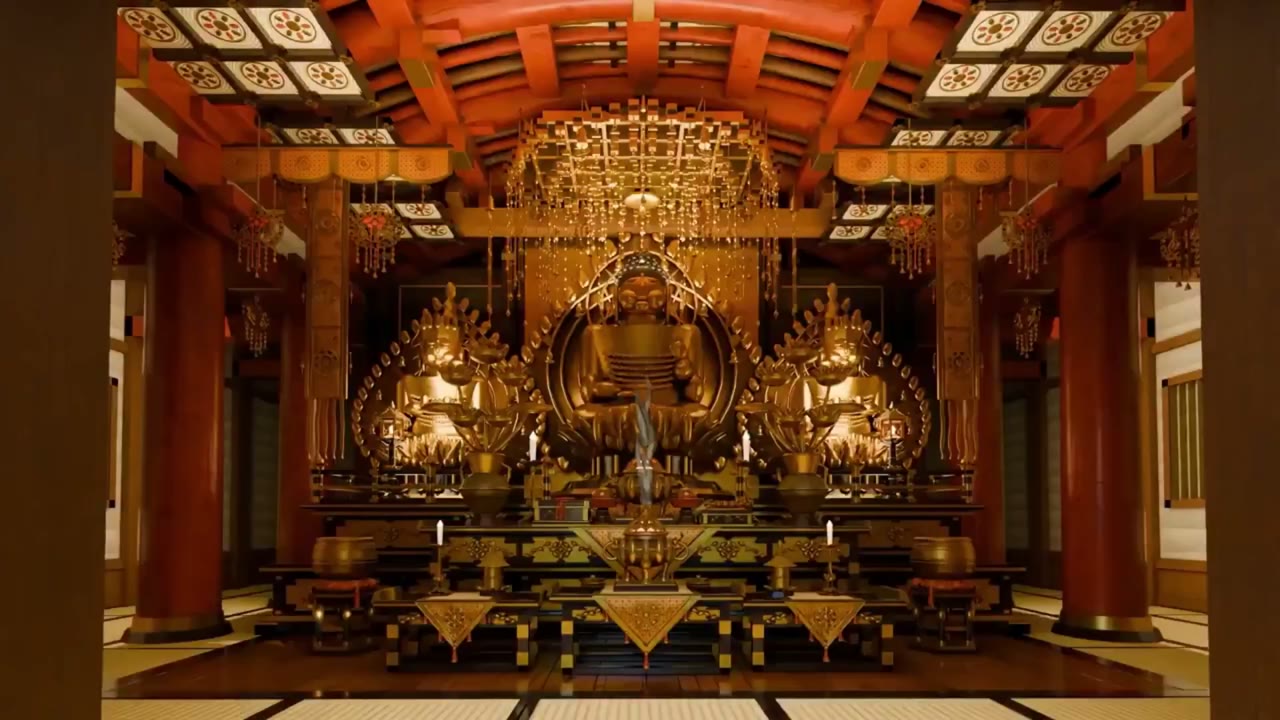
- Four parallel subagents, one per tile of the reference sheet, split the site: pagoda and roofs, joinery and cloisters, gate and gardens, the golden-hall interior. A master orchestrator doubles as an adversarial critic, checks Cycles renders against the sheet zone by zone and sends work back. On screen, every specialist is at pass 32.
- The next day came extra requests: animations, plus a procedurally generated temple bell and ambience.
The details that matter
- Rules live in the skill doc. The SKILL.md on screen fights the "too perfect CG" look: gobos for dappled shade, noise on light intensity, stacked micro-roughness, edge wear, a 35 mm camera with shallow depth of field.
- The reference is a target, not a tracing. The render adds a drum bridge and lotus pond the reference lacks, yet the five roofs and the hall's form match.
Where it breaks
- With no reference image the critic has nothing to measure against, and the loop never converges.
- Four agents editing one .blend overwrite each other. Give each its own collection.
Try it yourself
Write your rules down first, then adapt the Blender MCP build-rules prompt. Split roles as in multi-agent game dev and run the build with Blender MCP scene building[1][2].
References
- dotey's post with the subtitled demo and a Chinese summary x.com/dotey/status/2110129154272207315
- Google's Gemini 4 Argon launch post x.com/Google/status/2110041297360699856
Tags:#3D#Blender#Gemini#AI agents#Nano Banana#Photorealism
Written by the OpenDrama editors from a public post. Stills are quoted from the original video for commentary; tools, settings and steps are our own reconstruction. All rights in the original work stay with its creator — ask us and we take a still down.
Skills and prompts in this breakdown
More in 3D
View all →A little ghost on rainy water: a Three.js cloth shader, designed by GPT 6 Astra, coded by Opus 5.5
Chetan Ankola made a lantern-carrying ghost in the browser: rain, black water, fabric that flutters. GPT 6 Astra did the design, Claude Opus 5.5 wrote the Three.js. We look at the cloth, the light and five small interactions.
Same prompt, new result: Gemini 4 Argon builds a da Vinci workshop in Antigravity
maxescu re-ran @techhalla's exact Gemini 4 Argon vs Opus 5.5 prompt in Antigravity and got a four-machine da Vinci museum. How the scene is built, and why one run per model proves little.
Blender to the web: a glTF pipeline for Three.js and Unity
The export recipe for getting Blender scenes into browser games as small, fast GLB files: phone and desktop budgets for triangles and draw calls, baking, texture sizes, Draco/Meshopt/KTX2 trade-offs, naming, colliders and LODs.
Image-to-3D assets: from concept image to game-ready model
The full path from one concept image to a game-ready 3D model with Tripo, Meshy, Rodin or Hunyuan3D: input image rules, picking candidates, decimation and retopology budgets, UV and texture fixes, scale, pivot and export.